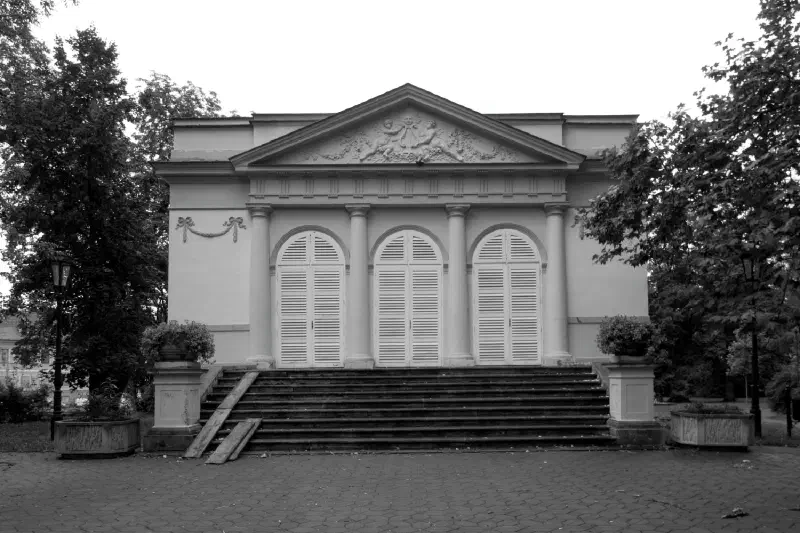
42 The Chateau Theatre
The Chateau Theatre was built for Jan Nepomuk Clary-Aldringen to a design by the Saxon architect Jan August Giesel. He designed a theatre for 285 spectators on the first floor of the newly extended west wing of the chateau. With an elegant Neoclassical façade, one of the first in this style in our country, he connected it directly with the chateau garden. The paintings that originally decorated the interior of the theatre have so far remained whitewashed over on the walls. The statues that once stood on both sides of the entrance staircase, however, have not survived.
Theatre life, which began in 1789, was very lively. An amateur company (Dilletantengesellschaft) soon formed. It was active mainly in winter and usually gave its takings to charity. Many touring theatre companies from elsewhere also came to Teplice, of course.
Besides them, the famous spa guest Goethe also wanted to have some fun here. Not only did he have his own lockable seat in the auditorium, but in 1812 he even wrote a play of his own for the theatre, “Die Wette”, or The Wager. In it he wrote a part for the young Empress Maria Ludovika, and he intended to perform at her side himself. The premiere, however, never took place. Goethe fell ill at the last moment, and on top of that the Empress’s husband firmly refused to let her take part.
Twenty-one years earlier, though, another famous guest had written another play here for another noble lady. Giacomo Casanova spent his old age at the chateau in nearby Duchcov, and he liked to visit the Teplice chateau and especially the backstage of its theatre. For Princess Marie Leopolda Kristina he wrote the play Le Polémoscope ou La calomnie démasqué par la présance d´esprit (The Deceptive Lorgnette, or Slander Unmasked by Presence of Mind). Unlike Goethe’s Wager, this one was actually performed, in 1791.
After the Municipal Theatre opened in 1874, the Chateau Theatre fell silent. For the next fifty years it was used only occasionally as a private stage. At the turn of the 1920s and 1930s, Alfons Clary-Aldringen had part of the decaying space converted into a flat. He used the larger part to house a collection of 60,000 books. The books came from the family palace in Vienna, which the family had to sell after the end of the First World War. Today the library holds the museum’s book collections.
More about this place
audioteplice.cz/42