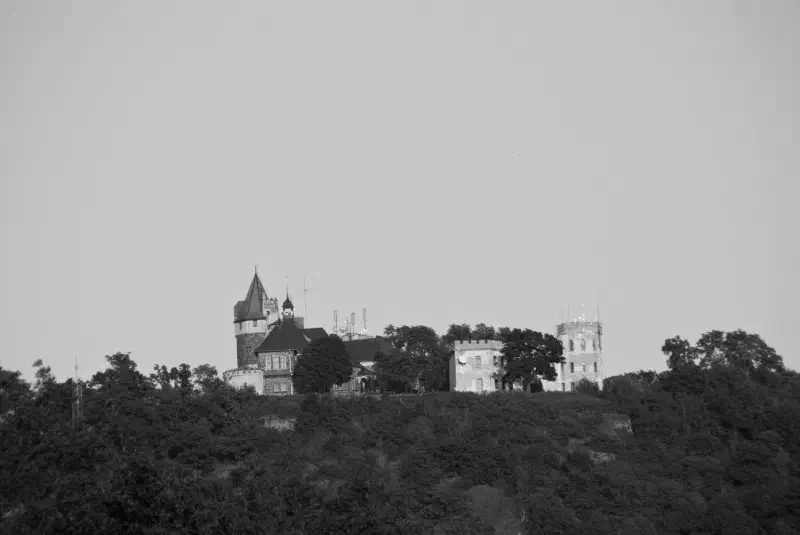
53 Doubravská hora
Doubravská hora is a phonolite hill 393 metres high, forming the northern tip of the České středohoří. It completes the skyline of the town and offers one of the widest views of Teplice and the surrounding area.
In 1478 Jan Ilburk of Vřesovice, the owner of the Teplice estate, built a castle on the top of the hill. It was surrounded by a wall on a roughly circular ground plan, with living quarters and service buildings standing against it on the inside. At short intervals, cylindrical towers, so-called flanking towers, were built into the wall, and you can still make out where they stood from the remains on the edge of the moat. From the flanking towers, defenders could shoot along the wall. This meant there was no dead ground at its foot that could not be hit from the battlements – there, archers would have had to lean out dangerously. By that time, however, this solution was already outdated, because artillery was beginning to dominate the battlefields of Europe.
To defend itself against cannon fire, Doubravka therefore gained a second ring of fortifications. This was a low but very massive wall with triangular projections. This kind of fortification is called a bastion system, and you can see it in a more perfect form in Terezín, for example. A moat, which is still very noticeable today, separated these fortifications from the inner castle.
The new system was soon put to the test. When the Thirty Years’ War engulfed Europe at the beginning of the 17th century, the Teplice estate was held by Vilém Vchynský. Although he was a Protestant, he kept the estate, because he supported the ruler in Vienna financially and even belonged to the retinue of the imperial generalissimo Albrecht of Valdštejn. That proved fatal for him: in 1634 he was murdered together with Valdštejn in Cheb, and the emperor confiscated Teplice. As a reward for his military successes, the estate went to General Jan Aldringen, who, however, never set foot in Teplice. But thanks to the new lords and to re-Catholicization, the German population of the town grew, replacing the old inhabitants killed by war and epidemics. It was at this time that Teplice became mainly German.
During the Thirty Years’ War, imperial, Saxon and Swedish armies took turns at Doubravka. After bitter experience had shown how hard it was to defend, the castle was demolished in 1655 so that no enemy could occupy it in the future.
The castle ruins were abandoned until the 19th century, which brought a new interest in romanticism, and so the place became a popular destination for walks by spa guests. In 1880, with the support of Edmund Clary-Aldringen, an excursion restaurant was built on the top, its architecture fulfilling the idea of the time of what a medieval castle looked like. Opposite it, in the 1970s, Svazarm (the Union for Cooperation with the Army) put up a new building, which was used for radio operations.
The restaurant building no longer serves its purpose today – the whole castle is used by radio amateurs. You are free to walk along the walls, but the interiors are open only on rare occasions.
More about this place
audioteplice.cz/53