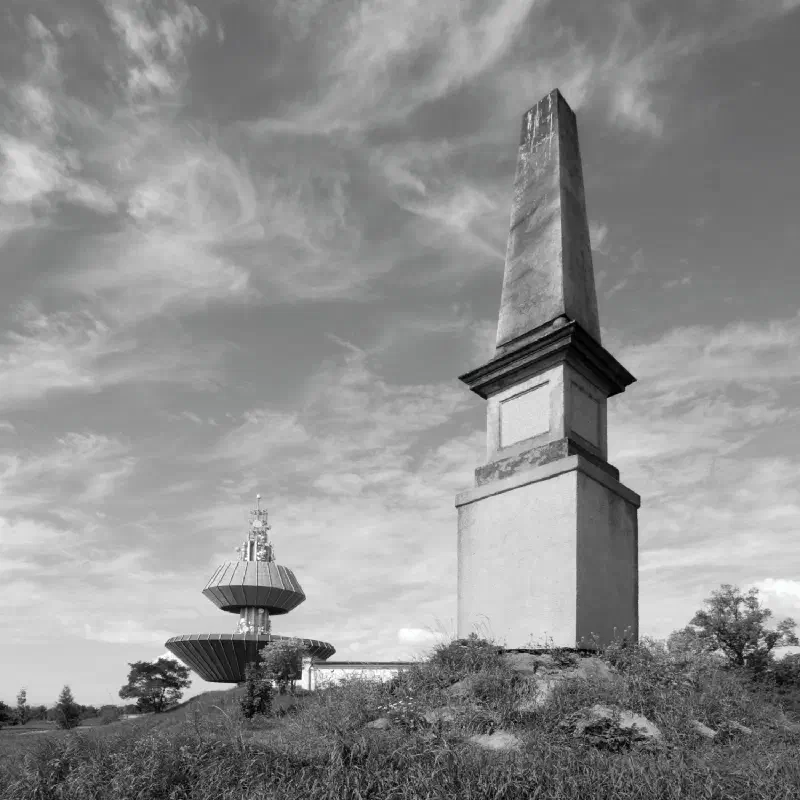
54 Hans Kudlich Monument
There is no recording in this language yet.
Nobody calls the hilltop in the south of Teplice, once known as Jalovčina, anything else but Kudlich today. The name, which is borne by many streets, squares and lookout towers in many places in Czechia, Austria and Germany, belongs to Hans Kudlich, in his day the youngest member of the Austrian Imperial Diet.
Hans Kudlich was born in 1823 in Úvalno on the Czech–Polish border. He studied philosophy and law and took part in the fighting in Vienna in the revolutionary year of 1848. Paradoxically, his real political career began when he came back to his native village to recover from a bayonet wound. The local people proposed him as a candidate for the Imperial Diet, and he was elected at the age of 25. There he put forward a proposal to abolish serfdom, and with it the robota, or forced labour, and it came into force in September 1848. He did not manage to do more, because the Diet was dissolved soon afterwards. Kudlich then joined various uprisings in Germany, but in the end he fled to Switzerland, where he studied medicine. Because he was sentenced to death in 1851 for his part in the revolutionary fighting, he emigrated to the United States of America, where he worked as a doctor. After he was pardoned by the emperor in 1867, he visited his homeland several times, but he returned for good, as he had wished, only after his death in 1917. So he did not live to see the end of the monarchy.
Many monuments to this brave deputy were put up throughout the monarchy; in 1888 the people of the Teplice region also won the right to one. On Jalovčina near Nová Ves, which offers an all-round view of the whole basin between the Ore Mountains and the České středohoří, a four-metre obelisk was erected. Its base was made of some one hundred and fifty stones carved with the names of the surrounding villages. Each stone lies so that it points from the obelisk towards its village. With four exceptions the inscriptions are German, and among them you will find several villages that disappeared after the war or because of coal mining. After more than a hundred years, however, some of them are hard to read.
In 1985 the monument had to make way for the construction of a water reservoir. At the beginning of the 1990s, it was put up again about 200 metres from its original site.
audioteplice.cz/54